
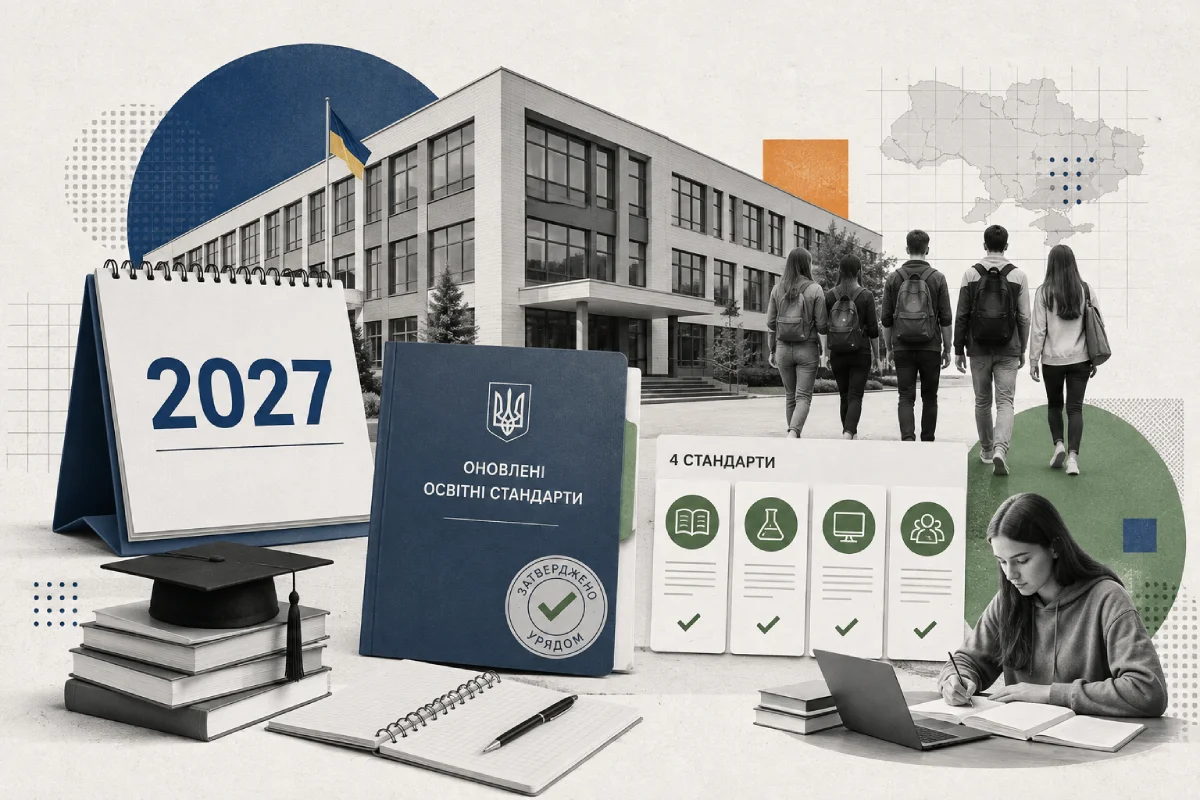
Starting from September 1, 2027, specialized secondary education will be launched in Ukraine. In preparation for this transition, the Cabinet of Ministers has updated four state standards for general secondary education - those approved in 2011, 2018, 2020, and 2024, as reported by the Ministry of Education and Science.
The goal of these changes is to prepare schools for the new system. Students who began their studies before the introduction of the New Ukrainian School will be able to complete them under the 2011 State Standard.
One of the most specific changes for middle school students is the addition of two hours within the basic curriculum for civic and historical educational subjects in grades 7-9.
Ukrainian Studies Component for Children Abroad and in Occupied Territories
A separate block concerns children who are abroad or in temporarily occupied territories. For them, special basic curricula with a Ukrainian studies component have been enshrined in the standards for primary, basic, and specialized secondary education. The Ministry of Education and Science explains that this approach will allow children to maintain a connection with the Ukrainian educational system without having to simultaneously complete two full educational programs.
Joint Plans for Lyceums and Vocational Education
The standard for specialized secondary education introduces joint curricula for academic lyceums, vocational education institutions, and professional pre-higher education institutions that provide specialized secondary education. This is intended to ensure uniform principles for organizing education regardless of the type of institution. Specialized schools will receive a separate basic plan with broader opportunities for in-depth study of subjects, specialized courses, electives, and individual lessons.
New Terminology in Inclusive Education
The standards also change the language used to describe students with special educational needs. Instead of medical diagnoses, the documents will record the child's functional difficulties during learning and the necessary level of support. For example, instead of the phrase "children with hearing impairment," the concept of "students with functional sensory difficulties involving hearing impairment" will be used. Similar changes cover difficulties related to vision, speech, musculoskeletal system, intellectual development, and other needs. The Ministry of Education and Science notes that this approach should allow for a greater focus on the child's abilities and development, rather than their medical status.
Overall, the updates touched upon curricula, the Ukrainian studies component, and approaches to inclusive education. Throughout August, the Ministry of Education and Science plans to clarify typical educational programs so that schools can organize the educational process in accordance with the new requirements.