

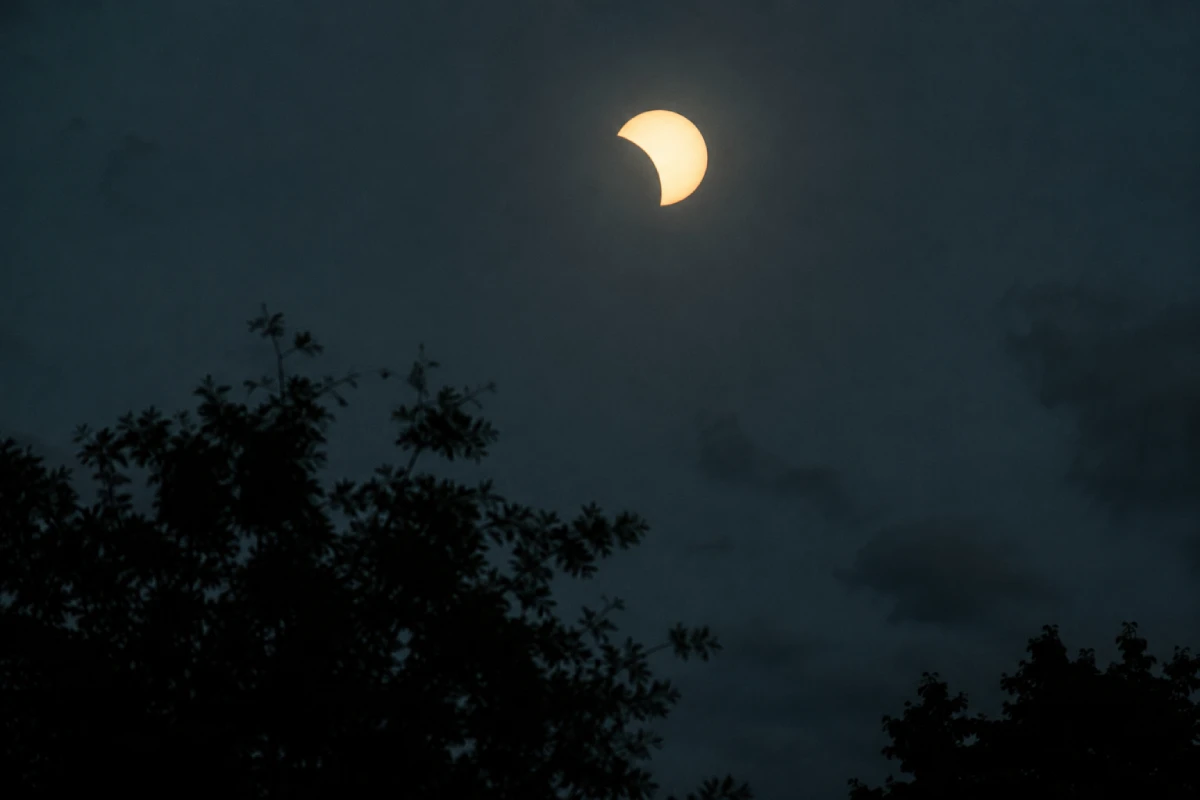
Most regions of Ukraine will see a partial solar eclipse on August 12, 2026, but conditions vary drastically depending on the city. Uzhhorod will have the best view: the Moon will cover about 43.4% of the solar disk, starting at 20:17-20:19 Kyiv time, with a maximum at 20:43-20:47. In Lviv, the coverage will be approximately 40.4% at the same time. Kyiv will only get nine minutes, from 20:14 to 20:23, and at its peak at 20:18, the Moon will cover only 2.7% of the Sun, which is practically imperceptible without special equipment. Kharkiv and Odesa will see nothing: the Sun sets there before the event begins or at that very moment.
Since the Sun will be very low above the horizon during the eclipse, observers will need an unobstructed view to the west or northwest, free of buildings, trees, or hills.
Safety during observation
Even with a partial eclipse, looking at the Sun without protection is dangerous: the risk of retinal burn remains throughout the event. Certified eclipse glasses are required. Regular sunglasses, smoked glass, and floppy disks do not block harmful infrared radiation.
Do not photograph with a smartphone or camera without a solar filter in front of the lens - intense light will instantly damage the sensor.
Smartphone owners are advised to use a tripod and hold eclipse glasses directly in front of the camera.
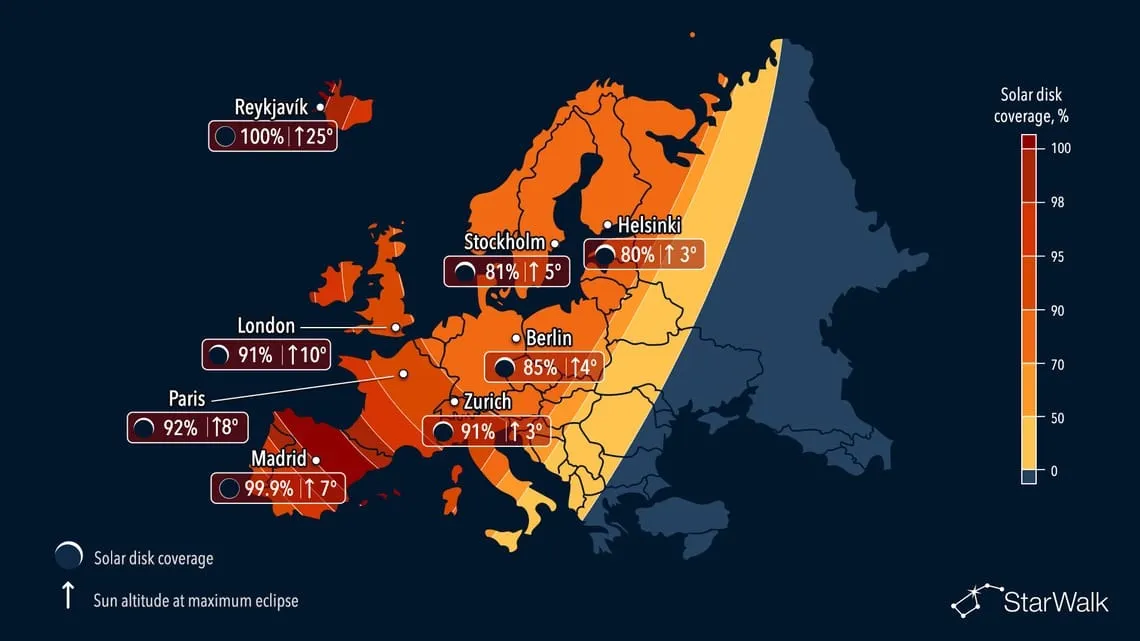
Globally, August 12, 2026, will be the first total solar eclipse visible from continental Europe since 1999. The Moon's shadow will travel about 8,300 kilometers - from the Arctic through Greenland, western Iceland, and northern Spain to the Mediterranean Sea near the Balearic Islands. The width of the path of totality is about 293 kilometers, with a maximum duration of 2 minutes 18.2 seconds over the North Atlantic.
For Reykjavík, this is the first total eclipse since 1433. In Spain, the event will occur during the "golden hour" before sunset against the backdrop of ancient castles and mountain landscapes.
In the path of totality, the solar corona will become visible - this is the outer atmosphere of the star, which is normally hidden by the bright photosphere. The Sun is currently in a phase of high activity, so the corona may appear particularly complex and structured, with noticeable prominences and flares. Pink plasma loops - prominences - may appear at the edge of the lunar disk. Immediately before and after totality, "Baily's beads" appear - bright points of light passing through valleys on the Moon's surface; the last bead forms the "diamond ring" effect. When the Sun is more than 80% obscured, the temperature noticeably drops, and the light takes on an unusual "metallic" hue.